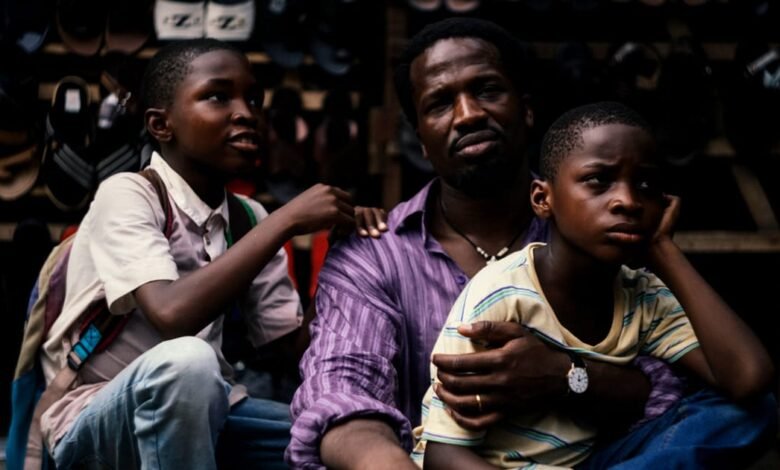

The outskirts of Lagos, 1993: a harried father, Folarin (Sope Dirisu), returning to his tumbledown home, makes the snap decision to scoop up his two bored, young sons and take them on a road trip into central Lagos to collect wages owed to him. He has an ulterior motive – he wants them all be at ground zero when the results of a national election are announced and, all being well, MKO Abiola triumphs over the ruling military junta and brings democracy back to Nigeria.
Folarin proceeds with an element of caution, knowing that he has for too long been an absent father, earning money from what he has been telling the boys is a far-flung factory job, while he has actually been working as a political lobbyist for Abiola. His duty of care extends to making sure that his sons have a better future, and in many ways this affecting and beautifully judged first feature from Akinola Davies Jr is about a father wanting his kids to see first hand the fruits of his (often dangerous) labours and understand that he has been there for them on a national level, even if he hasn’t on a personal one.
Get more Little White Lies
This entire review could be dedicated to the immense central performance by Dirisu, who, as the eternally conflicted father, is withholding a lot of information from his family for their safety. He also seems to have to alter personas with every new person he encounters. Initially, he’s a stern father who wants his boys (incredibly natural and funny performances by Chibuike Marvellous Egbo and Godwin Chiemerie Egbo) to understand a bit more about the country they’re living in, but perhaps not too much. Soon he becomes the desperate grafter who urgently needs wages for upkeep; then he’s the shady political operative who people refer to as “Kapo” as he tucks a few notes in their pocket for survival.
At the centre of a film is a dialogue scene on a beach in which the father leaves himself open for questioning and is able to impart both his wisdom and an attempt to furtively cultivate a sense of national pride in his inquisitive offspring. Dirisu channels tenderness, but his righteous indignation bubbles beneath the surface. Yet their conversation is cut short by a gang of marauders suddenly hacking chunks off of a beached whale, the film constantly leaning on the interplay between the protagonists and the strange things occurring in the backdrop.
The direction by Davies Jr is top-notch, not just in how he is able to capture the fine nuances of the actors on camera, but also in how they are immersed in the chaotic mêlée of Lagos at this powder-keg moment. The plot ends up hinging on some strange coincidences, and the ending perhaps withholds a little too much detail for it’s own good, but otherwise this is a very fine picture on a formal and emotional level.