Why Neighborhood Targeting Beats EDDM for Contractors

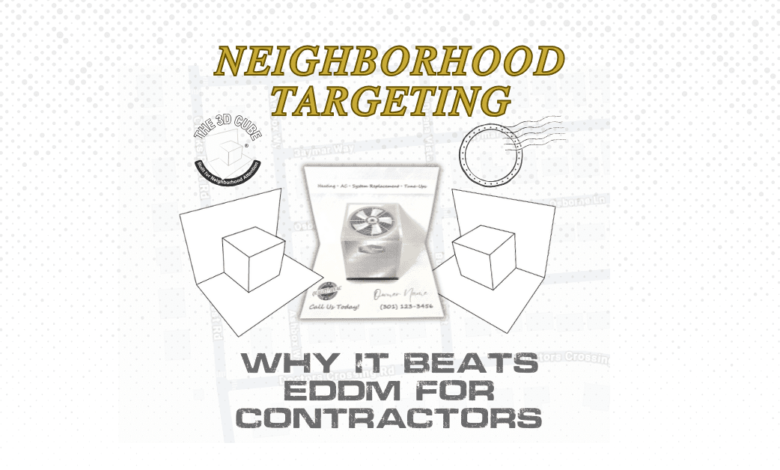
Every Door Direct Mail appeals to contractors because it promises scale and simplicity. In practice, broad saturation often creates waste, poor timing, and weak relevance. Neighborhood direct mail targeting takes the opposite approach. It limits reach on purpose, aligns delivery with visible work, and focuses only on homeowners most likely to care.
For contractors working in tight suburban and semi rural markets, targeted neighborhood mail consistently outperforms EDDM.
What EDDM Is Designed to Do
EDDM is built for volume. Pieces are delivered to every address on a carrier route regardless of ownership, project timing, or service relevance.
Structural Limitations of EDDM
No filtering for owner occupied homes
No connection to active or recent work
High percentage of renters and non decision makers
Fixed delivery timing unrelated to job schedules
The result is exposure without context. Visibility does not equal relevance.

How Neighborhood Targeting Works Differently
Neighborhood targeting starts with a real job, not a route map. Mail is delivered only to nearby owner occupied homes surrounding an active or recently completed project.
Core Differences From EDDM
Addresses selected by proximity to visible work
Owner occupied screening using public records
Delivery timed before or after the job
Small runs designed for attention, not saturation
This structure answers the homeowner’s first question immediately. Why am I getting this?
Waste Reduction Through Precision
EDDM waste is built in. Neighborhood targeting removes it at the source.
Where Waste Is Eliminated
Renters and vacant properties excluded
Multi unit buildings avoided when inappropriate
Out of area curiosity clicks avoided
Excess print volume removed
Contractors pay only for impressions with a plausible path to response.
Timing Matters More Than Frequency
EDDM operates on postal schedules. Neighborhood targeting operates on job schedules.

Why Timing Drives Response
Homeowners already noticed the work
Curiosity peaks during and after projects
Mail arrives when questions already exist
No need to manufacture urgency
This timing advantage cannot be replicated with route based saturation.
Relevance Builds Trust Faster Than Offers
EDDM often relies on discounts to force attention. Neighborhood targeting relies on proximity.
Trust Signals Neighborhood Mail Creates
The contractor worked nearby
The work is visible and verifiable
The message explains context, not incentives
The piece feels informational, not promotional
Trust forms before any sales conversation begins.
Local Reality in Southern Maryland
Communities across Southern Maryland are defined by close neighborhoods, visible exterior work, and strong word of mouth. Counties such as St. Mary’s County, Calvert County, and Charles County feature housing patterns where one project is noticed by dozens of surrounding homeowners.
In these areas, EDDM often reaches beyond the neighborhood where awareness already exists. Targeted mail stays inside it.
Northern Neck Virginia Has Similar Dynamics
The Northern Neck presents a comparable environment. Smaller towns, lower density routes, and strong community awareness define counties such as Lancaster County, Northumberland County, and Richmond County.
EDDM routes in these areas often stretch across miles of unrelated properties. Neighborhood targeting stays anchored to the immediate area where work occurred.
Measurement Is Clearer With Targeted Mail
Large EDDM drops make attribution difficult. Small neighborhood runs make it obvious.
Why Results Are Easier to Track
Limited address count
Clear delivery window
Responses tied to a specific job
Fewer variables in play
Contractors quickly learn which services and neighborhoods perform best.
Cost Control Without Cutting Impact
EDDM lowers cost per piece but raises cost per meaningful impression. Neighborhood targeting does the opposite.
Practical Cost Advantages
Lower total spend per campaign
Faster turnaround between jobs
Reusable format across multiple neighborhoods
No inventory sitting unused
Impact comes from relevance, not repetition.
When EDDM Still Makes Sense
EDDM can work for grand openings, retail promotions, or awareness campaigns without geographic specificity. For contractors whose work is already visible and local, it is rarely the most efficient tool. Capitalizing on interest and curiosity buily from contractor trucks already making noise and appearances in homeowner’s neighborhoods is key. The conversation goes from “I wonder what the neighbors have going on next door” to “oh, wow, look at we can have done as well”.
Conclusion
Neighborhood targeting beats EDDM because it respects how homeowners actually behave. People respond to what they already noticed, not what arrives at random.
For contractors in Southern Maryland and the Northern Neck of Virginia, relevance, timing, and proximity consistently outperform saturation.

Ronnie Lee Roberts II is a part owner and principal of R.L. Roberts II Design, LLC, a design studio specializing in high-impact direct mail and production-ready graphics. His background combines professional graphic design, technical documentation, and quality management, with a strong focus on custom 3DC® mailers designed for real-world use rather than presentation alone.
His work centers on dimensional direct mail programs for home-service businesses, including targeted 3DC® campaigns tied to recent projects and neighborhood outreach. Additional experience includes facilities and wayfinding graphics, service-based marketing materials, and structured documentation for regulated and mission-driven organizations such as The Arc and United Way. His approach emphasizes clarity, consistency, and effectiveness across print and physical marketing environments.
Source link